Electric Charge & Its Properties
📌 What is Electric Charge?
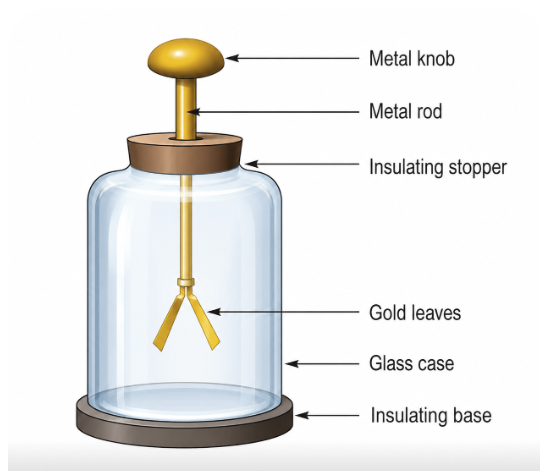
Electric charge is a fundamental property of matter. There are two types — positive (on glass rod rubbed with silk) and negative (on plastic rod rubbed with cat's fur). Like charges repel; unlike charges attract. SI unit of charge = Coulomb (C).
📌 Three Basic Properties of Charge
(i) Additivity: Total charge = algebraic sum of all charges. Charges are scalars.
(ii) Conservation: Total charge of an isolated system is always conserved. No new charge is created or destroyed — only transferred.
(iii) Quantisation: q = ne, where n is integer and e = 1.6 × 10⁻¹⁹ C (charge on electron/proton).
Charge on proton: e = +1.602 × 10⁻¹⁹ C
Quantisation: q = ne (n = 0, ±1, ±2, ...)
1 μC = 10⁻⁶ C | 1 mC = 10⁻³ C
🎯 Practice MCQs
Total = (+3) + (−5) + (+2) + (−4) = −4 μC. Charges add algebraically.
n = q/e = (1.6 × 10⁻¹³) / (1.6 × 10⁻¹⁹) = 10⁶ electrons.
No new charges are created. Electrons (mobile charges) transfer from glass to silk, making glass positive and silk negative.
Coulomb's Law & Superposition Principle
📌 Coulomb's Law
The electrostatic force between two point charges q₁ and q₂ separated by distance r in vacuum acts along the line joining them and is: directly proportional to the product of charges, and inversely proportional to the square of the distance.
or F = (1/4πε₀) × |q₁q₂| / r²
k = 9 × 10⁹ N m² C⁻²
ε₀ = 8.854 × 10⁻¹² C² N⁻¹ m⁻²
Vector form: F₂₁ = (1/4πε₀) × (q₁q₂/r²₂₁) r̂₂₁
📌 Superposition Principle
The force on a charge due to multiple other charges = vector sum of individual Coulomb forces. Each pair's force is unaffected by the presence of other charges.
F₁ = F₁₂ + F₁₃ + F₁₄ + ...
🎯 Practice MCQs
F = 9×10⁹ × (2×10⁻⁷ × 3×10⁻⁷) / (0.3)² = 9×10⁹ × 6×10⁻¹⁴ / 0.09 = 6 × 10⁻³ N.
Fe/Fg = e² / (4πε₀ G mₑ mₚ) ≈ 2.4 × 10³⁹. Electric forces are enormously stronger than gravity.
F ∝ 1/r². If r → r/2, F → F/(r/2)² × r² = 4F.
Electric Field & Electric Field Lines
📌 Electric Field
The electric field E at a point is the force experienced by a unit positive test charge placed at that point (without disturbing the source charge). It is a vector quantity. Unit: N/C or V/m.
Relation to force: F = qE
Defined as: E = lim(q→0) F/q
Due to system of n charges: E(r) = Σ (1/4πε₀) × qᵢ/rᵢₚ² r̂ᵢₚ
📌 Properties of Electric Field Lines
(i) Field lines start at positive charges and end at negative charges.
(ii) In a charge-free region, field lines are continuous curves — no sudden breaks.
(iii) Two field lines can never cross each other (unique direction at every point).
(iv) Electrostatic field lines do not form closed loops.
(v) Density of field lines represents the strength of E.
🎯 Practice MCQs
At midpoint, both fields point in the same direction (toward −q). Each E = 9×10⁹ × 3×10⁻⁶ / (0.1)² = 2.7×10⁶ N/C. Total = 2 × 2.7×10⁶ = 5.4×10⁶ N/C.
Note: Correct answer is C) 5.4 × 10⁶ N/C — both fields add.
E ∝ 1/r². Distance tripled → E → E/(3)² = E/9.
Two field lines can NEVER cross each other at any angle. If they crossed, the field at that point would have two directions — which is physically impossible.
Electric Dipole & Electric Flux
📌 Electric Dipole
An electric dipole is a pair of equal and opposite charges +q and −q separated by distance 2a. The dipole moment p = q × 2a, directed from −q to +q. Unit: C·m. Water (H₂O) is a natural polar molecule.
On equatorial plane (r >> a): E = −p / (4πε₀ r³) [opposite p̂]
Torque in uniform field: τ = p × E = pE sinθ
Note: Dipole field ∝ 1/r³ (vs 1/r² for point charge)
📌 Electric Flux
Electric flux through area element ΔS: Δφ = E · ΔS = E ΔS cosθ
where θ is angle between E and the normal to surface. Unit: N·C⁻¹·m² or V·m.
Total flux: φ = Σ E · ΔS
🎯 Practice MCQs
p = q × 2a = 10⁻⁵ C × 5 × 10⁻³ m = 5 × 10⁻⁸ C·m.
τ = pE sinθ = pE sin30° = pE × ½ = pE/2.
φ = E × ΔS × cosθ = 500 × 0.02 × cos0° = 10 N·m²/C.
Gauss's Law & Applications
📌 Gauss's Law
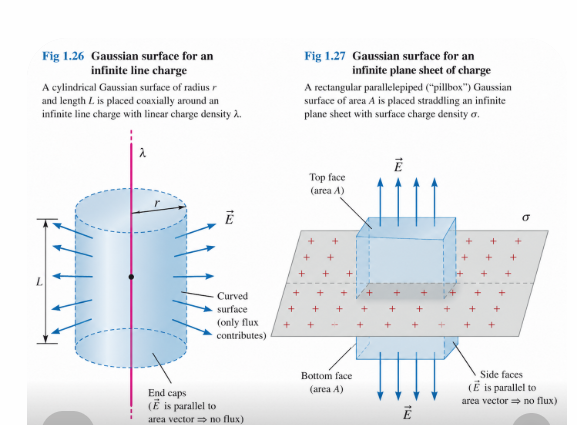
The total electric flux through any closed surface S is equal to the total charge enclosed by S divided by ε₀.
φ = q_enc / ε₀
This holds for any closed surface (Gaussian surface) of any shape or size. The Gaussian surface must not pass through discrete charges.
E = λ / (2πε₀ r) [radially outward]
Infinite plane sheet (surface density σ):
E = σ / (2ε₀) [perpendicular, both sides]
Spherical shell (charge Q, radius R):
E = Q / (4πε₀ r²) for r ≥ R [outside]
E = 0 for r < R [inside — zero field]
📌 Key Result: Field Inside a Shell = Zero
For a uniformly charged thin spherical shell, the electric field at all interior points is exactly zero. This is a direct consequence of Gauss's Law and the 1/r² nature of Coulomb's law. Experimentally verified — confirms inverse-square law.
🎯 Practice MCQs
φ = q/ε₀ = (2 × 10⁻⁶) / (8.854 × 10⁻¹²) = 2.26 × 10⁵ N·m²/C. Shape of surface is irrelevant.
By Gauss's law, for any Gaussian surface inside the shell, charge enclosed = 0 → E × 4πr² = 0 → E = 0.
E = λ/(2πε₀r) = (2×10⁻⁸) / (2π × 8.854×10⁻¹² × 0.1)
= 2×10⁻⁸ / (5.56×10⁻¹²) ≈ 3600 N/C.
📚 Chapter Summary — Electric Charges & Fields
⚡ Conquer AAI ATC Physics!
Watch full video explanations, practice more problems, and get all your doubts solved.