

Currently Empty: $0.00

1.Electric Charge & Coulomb’s Law
Class 12 • Physics • NCERT
Electric Charges and Fields
NCERT-aligned lesson on electric charge, Coulomb’s law, superposition principle, electric field, field lines and electric flux. Designed specially for AAI ATC and competitive exam preparation.
Lesson Objectives
- Understand electric charge and its basic properties.
- Apply Coulomb’s law to calculate electrostatic force.
- Use the superposition principle for multiple charges.
- Define and calculate electric field and electric flux.
- Interpret electric field lines.
Introduction to Electrostatics
Electrostatics deals with the study of electric charges at rest and the forces, fields, and potentials associated with them. Common phenomena like lightning, sparks while removing sweaters, and attraction of light objects after rubbing are due to static electricity.
Key Idea: Charges interact even without physical contact → explained using the concept of electric field
1. Electric Charge
Electric charge is a fundamental property of matter responsible for electrical interactions. There are two types of charges: positive and negative.
- Like charges repel, unlike charges attract.
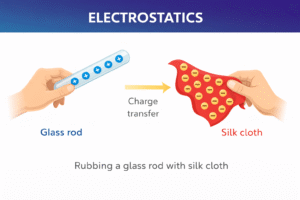
- Charge is transferred by electrons.
- No charge is created or destroyed.
- Convention:
Glass rod → +ve, Silk → −ve
q = ne, where e = 1.6 × 10⁻¹⁹ C
- Conductors: Metals, human body, earth (free electrons).
- Insulators: Glass, plastic, rubber, wood.
Charge distributes over surface of a conductor but remains localized on an insulator.
. Basic Properties of Electric Charge
(a) Additivity
Total charge = algebraic sum of individual charges.
(b) Conservation of Charge
Net charge of an isolated system remains constant.
(c) Quantisation
q = ne, n ∈ ℤ
Where e = 1.6 × 10⁻¹⁹ C
2. Coulomb’s Law
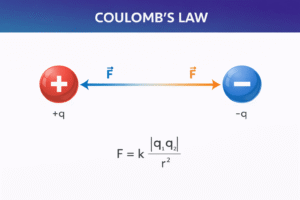
The force between two point charges q₁ and q₂ separated by distance r:
F = (1 / 4πϵ₀) · (|q₁q₂| / r²)
- ϵ₀ = 8.854 × 10⁻¹² C² N⁻¹ m⁻²
- k = 9 × 10⁹ N m² C⁻²
3. Superposition Principle
The net force on a charge due to many charges is the vector sum of forces due to each charge separately.
Fnet= Σ Fᵢ
4. Electric Field
Electric field at a point is defined as force per unit positive test charge.
E= F / q
E = (1 / 4πϵ₀) · (Q / r²) · r̂
[ DIAGRAM SPACE: Field of point charge ]
5. Electric Field Lines
- Start from +ve and end at −ve charges.
- Never intersect.
- Density ∝ field strength.
- Tangent gives direction of field.
[ DIAGRAM SPACE: Field lines of dipole ]
6. Electric Flux
Electric flux through surface dS:
ϕ = E⃗ · dS⃗ = E dS cosθ
[ DIAGRAM SPACE: Area vector and flux ]
AAI ATC Practice MCQs
- Two charges +q and −4q are separated by d. Where is E = 0?
A) Between them nearer +q
B) Between nearer −4q
C) Outside nearer +q
D) Outside nearer −4q - 10⁹ electrons leave a conductor each second. Current equals:
A) 1.6×10⁻¹⁰ A
B) 1.6×10⁻⁹ A
C) 0.16 A
D) 16 A - A body has charge 4.8 μC. Excess electrons = ?
A) 3×10¹³
B) 3×10¹²
C) 1.6×10¹³
D) 6×10¹² - Two identical spheres with +10 μC and −6 μC touch. Final charge on each:
A) +2 μC
B) +4 μC
C) +1 μC
D) +3 μC - Electric field inside a conductor is:
A) Maximum
B) Minimum
C) Zero
D) Infinite - If r doubles, Coulomb force becomes:
A) Half
B) One-fourth
C) Double
D) Same - Electric field zero at midpoint between:
A) +q and +q
B) +q and −q
C) −q and −q
D) +2q and −2q - Field line density represents:
A) Potential
B) Force
C) Flux
D) Field strength - Electric flux unit:
A) N C⁻¹
B) C m⁻²
C) N m² C⁻¹
D) V m - Superposition means:
A) Charges add
B) Fields add vectorially
C) Forces cancel
D) Flux constant
✅ Show Answer Key
1. C 2. A 3. A 4. A 5. C 6. B 7. A 8. D 9. C 10. B
© Aviate Learning – Electric Charges and Fields (NCERT)