Currently Empty: ₹0.00




⚗️ The Order of Metals and Carbon in the Reactivity Series
Where Learning Takes Flight
GCSE Chemistry
Grade 8-9
60 Minutes
Intermediate
📋 Syllabus Alignment
GCSE Chemistry - Reactivity Series Official Requirements:
This lesson aligns with the GCSE Chemistry curriculum specifications for the reactivity series of metals and carbon. Students are required to understand the relative reactivity of metals and the position of carbon within the reactivity series.
Exact Learning Outcomes:
- Recall and state the order of metals and carbon in the reactivity series
- Explain what the reactivity series is and what it tells us about metals
- Predict displacement reactions based on the position of metals in the reactivity series
- Understand why carbon is included in the reactivity series
- Use the reactivity series to determine which metals can be extracted from their ores using carbon
- Apply knowledge of the reactivity series to explain observations in experiments
- Compare the reactivity of different metals based on their position in the series
🤔 What Actually IS the Reactivity Series?
The reactivity series is a list of metals arranged in order of their reactivity, from the most reactive at the top to the least reactive at the bottom. But what does "reactive" really mean? A reactive metal is one that readily loses electrons to form positive ions (cations). The more easily a metal loses its electrons, the more reactive it is!
Think of it like a competition where metals are racing to give away their electrons. Some metals are desperate to lose electrons (highly reactive), while others hold onto them tightly (less reactive). This property determines how metals behave in chemical reactions, including how they react with water, acids, and other metal compounds.
💡 Explanation:
The reactivity series is essential in chemistry because it helps us predict:
- Whether a displacement reaction will occur
- How vigorously a metal will react with water or acid
- Which method should be used to extract a metal from its ore
- How easily a metal corrodes
Carbon is included in the reactivity series even though it's a non-metal. This is crucial for understanding metal extraction, as metals less reactive than carbon can be extracted from their ores using carbon in a process called reduction.
📖 Example:
The standard reactivity series (from most to least reactive):
Potassium (K) - Most reactive
Sodium (Na)
Calcium (Ca)
Magnesium (Mg)
Aluminium (Al)
CARBON (C) - Non-metal included for extraction purposes
Zinc (Zn)
Iron (Fe)
Tin (Sn)
Lead (Pb)
Copper (Cu)
Silver (Ag)
Gold (Au) - Least reactive
🔧 Worked Problem:
Question: Using the reactivity series, explain why gold jewellery doesn't tarnish or corrode, but iron jewellery rusts easily.
Solution:
Step 1: Locate both metals in the reactivity series.
Gold is near the bottom (least reactive), while iron is in the middle.
Step 2: Consider what reactivity means.
Iron is more reactive, meaning it readily loses electrons and reacts with oxygen and water in the air to form iron oxide (rust).
Step 3: Apply to gold.
Gold is very unreactive, so it doesn't readily react with oxygen or water. This is why gold jewellery maintains its shine and doesn't corrode.
Answer: Gold is much less reactive than iron according to the reactivity series. Iron easily reacts with oxygen and water to form rust, while gold is so unreactive that it doesn't corrode or tarnish under normal conditions.
📸
Reactivity Series of Metals
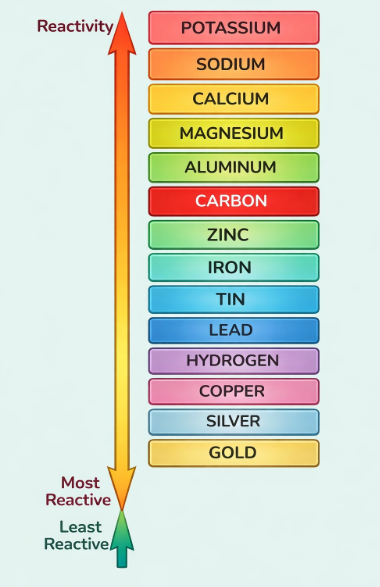
Metals are arranged from most reactive (top) to least reactive (bottom).
Carbon is placed in the middle and is important in extraction processes.
🔥 Why Does Reactivity Decrease Down the Series?
Have you ever wondered why some metals explode when they touch water (like sodium), while others barely react at all (like gold)? The answer lies in the electronic structure of atoms and how easily they lose electrons!
💡 Explanation:
Metal reactivity is all about losing electrons. When metals react, they lose electrons from their outer shell to form positive ions. The easier it is for a metal to lose electrons, the more reactive it is.
Factors affecting reactivity:
- Number of electron shells: More shells mean the outer electrons are further from the nucleus and less strongly attracted
- Nuclear charge: The number of protons in the nucleus affects how strongly electrons are held
- Shielding effect: Inner electrons shield outer electrons from the full nuclear charge
For example, potassium has its outer electron very far from the nucleus with lots of shielding, so it loses this electron extremely easily. Gold, on the other hand, holds its electrons much more tightly, making it very unreactive.
📖 Example:
Comparing sodium and magnesium with water:
Sodium (Na): Reacts vigorously with cold water, fizzing rapidly across the surface, producing hydrogen gas and sodium hydroxide. The reaction releases so much heat that the sodium may melt.
2Na + 2H₂O → 2NaOH + H₂
Magnesium (Mg): Reacts very slowly with cold water (you might not even notice), but reacts vigorously with steam to produce magnesium oxide and hydrogen.
Mg + H₂O(steam) → MgO + H₂
Sodium is higher in the reactivity series, so it reacts much more vigorously than magnesium with water.
🔧 Worked Problem:
Question: Calcium, magnesium, and zinc all react with dilute hydrochloric acid. Predict the order of reactivity (fastest to slowest) and explain your reasoning.
Solution:
Step 1: Find each metal in the reactivity series.
Calcium is above magnesium, and magnesium is above zinc in the series.
Step 2: Apply the reactivity principle.
The higher a metal is in the reactivity series, the more reactive it is and the faster it will react with acid.
Step 3: Order the metals.
From fastest to slowest: Calcium → Magnesium → Zinc
Answer: Calcium will react fastest (vigorous fizzing), followed by magnesium (moderate fizzing), and zinc will react slowest (slow fizzing). This is because calcium is most reactive, being highest in the reactivity series, while zinc is least reactive of the three.
⚔️ What Are Displacement Reactions and How Do They Work?
Imagine a game of musical chairs where the strongest players can kick out weaker ones to take their seats. Displacement reactions work exactly like this! A more reactive metal can "kick out" a less reactive metal from its compound. This is one of the most important applications of the reactivity series.
💡 Explanation:
A displacement reaction occurs when a more reactive metal replaces a less reactive metal in a compound. The general rule is simple:
A more reactive metal will displace a less reactive metal from its compound.
This happens because the more reactive metal has a greater tendency to form ions (lose electrons). It will "steal" the compound away from the less reactive metal, forcing the less reactive metal out as pure metal atoms.
The displacement rule:
- If metal A is above metal B in the reactivity series, then A can displace B from its compounds
- If metal A is below metal B, then NO reaction occurs
- The further apart the metals are in the series, the more vigorous the reaction
📖 Example:
Zinc displacing copper from copper sulfate:
When zinc metal is placed in blue copper sulfate solution, the blue color fades and copper metal forms on the zinc. The solution becomes colorless zinc sulfate.
Zn + CuSO₄ → ZnSO₄ + Cu
Why does this happen? Zinc is above copper in the reactivity series, so it's more reactive. Zinc displaces copper from the copper sulfate compound.
What if we tried the opposite? If we placed copper in zinc sulfate solution, nothing would happen because copper is less reactive than zinc and cannot displace it.
🔧 Worked Problem:
Question: Predict what will happen in each of the following situations. Write the word equation if a reaction occurs, or state "no reaction" if nothing happens:
a) Magnesium ribbon placed in iron(II) sulfate solution
b) Silver metal placed in zinc nitrate solution
c) Iron nail placed in copper(II) chloride solution
Solution:
a) Magnesium + iron(II) sulfate:
Step 1: Check positions - Magnesium is above iron in the series
Step 2: More reactive displaces less reactive - Reaction occurs!
Word equation: magnesium + iron(II) sulfate → magnesium sulfate + iron
b) Silver + zinc nitrate:
Step 1: Check positions - Silver is below zinc in the series
Step 2: Less reactive cannot displace more reactive
Result: No reaction
c) Iron + copper(II) chloride:
Step 1: Check positions - Iron is above copper in the series
Step 2: More reactive displaces less reactive - Reaction occurs!
Word equation: iron + copper(II) chloride → iron(II) chloride + copper
📸
Displacement Reaction: Zinc & Copper Sulfate
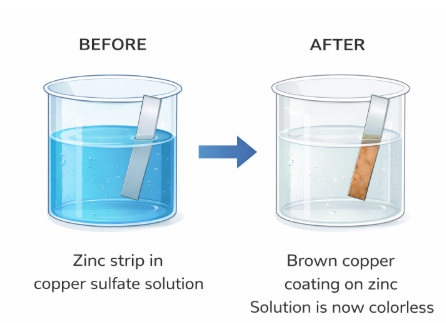
Before: Zinc strip in blue copper sulfate solution
After: Brown copper deposits on zinc and solution becomes colorless
Still confused? Book a FREE 1-on-1 Trial Lesson!
Get personalised guidance from an expert tutor - completely free.
Book My Free Trial🏭 Why Is Carbon in the Reactivity Series If It's Not Even a Metal?
This is a brilliant question! Carbon isn't a metal, so why on earth would we put it in a series of metals? The answer is both practical and fascinating - carbon's position in the reactivity series is the key to understanding how we extract metals from their ores on an industrial scale!
💡 Explanation:
Carbon is placed in the reactivity series because it can "compete" with metals for oxygen. Most metals in nature are found as metal oxides (combined with oxygen) in ores. To extract the pure metal, we need to remove the oxygen - a process called reduction.
The carbon extraction rule:
- Metals below carbon in the reactivity series can be extracted from their oxides by heating with carbon
- Metals above carbon in the reactivity series cannot be extracted using carbon - they require electrolysis (using electricity)
- Carbon is more reactive than the metals below it, so it can displace them from their oxides
When we heat a metal oxide with carbon, the carbon "steals" the oxygen from the metal oxide, forming carbon dioxide and leaving the pure metal behind. This only works if carbon is more reactive than the metal (i.e., the metal is below carbon in the series).
📖 Example:
Extracting iron from iron oxide (in a blast furnace):
Iron is below carbon in the reactivity series, so we can extract it using carbon (in the form of coke). The carbon reacts with the iron oxide to produce iron and carbon dioxide.
2Fe₂O₃ + 3C → 4Fe + 3CO₂
Why can we use carbon for iron but not for aluminium?
Aluminium is above carbon in the reactivity series, so carbon cannot displace it from aluminium oxide. Instead, aluminium must be extracted using electrolysis, which is much more expensive. This is why aluminium products cost more than steel (iron) products!
🔧 Worked Problem:
Question: A company wants to extract the following metals from their ores: copper, magnesium, zinc, and sodium. For each metal, state whether it can be extracted using carbon or whether electrolysis is required. Explain your reasoning.
Solution:
Step 1: Write out the relevant part of the reactivity series with carbon included:
Sodium > Magnesium > Aluminium > CARBON > Zinc > Iron > Copper
Step 2: Apply the rule - metals below carbon can be extracted with carbon; metals above carbon need electrolysis.
Copper: Below carbon → Can be extracted using carbon (heating copper oxide with carbon)
Magnesium: Above carbon → Requires electrolysis (too reactive to be extracted with carbon)
Zinc: Below carbon → Can be extracted using carbon (heating zinc oxide with carbon)
Sodium: Above carbon → Requires electrolysis (far too reactive to be extracted with carbon)
Conclusion: Copper and zinc can be extracted cheaply using carbon reduction. Magnesium and sodium require expensive electrolysis because they are more reactive than carbon.
🧪 How Can We Investigate Reactivity Experimentally?
The reactivity series isn't just a list someone made up - it's based on real experimental observations! Scientists have conducted countless experiments to determine the order of metals. But how exactly do we compare reactivity in the lab?
💡 Explanation:
There are several experimental methods to compare metal reactivity:
1. Reactions with dilute acid:
Add equal-sized pieces of different metals to dilute hydrochloric acid or sulfuric acid. The more reactive the metal, the faster it fizzes (produces hydrogen gas). We can measure the rate of reaction by timing how long it takes to produce a certain volume of gas, or by observing the vigor of fizzing.
2. Displacement reactions:
Place different metals in metal salt solutions. If metal A displaces metal B from solution, then A is more reactive than B. By testing multiple combinations, we can build up the full order.
3. Reactions with water or steam:
Very reactive metals (like sodium and potassium) react with cold water. Moderately reactive metals (like magnesium) react slowly with cold water but vigorously with steam. Less reactive metals don't react with water at all.
4. Ease of oxidation:
How easily does a metal corrode or tarnish when exposed to air? More reactive metals oxidize (lose electrons) more readily.
📖 Example:
Comparing magnesium, zinc, and copper with dilute hydrochloric acid:
Magnesium: Fizzes rapidly and vigorously, producing lots of hydrogen gas bubbles. The metal strip dissolves quickly. The reaction is noticeably exothermic (test tube feels warm).
Zinc: Fizzes steadily but less vigorously than magnesium. Produces hydrogen gas at a moderate rate. Takes longer to dissolve than magnesium.
Copper: No visible reaction. The copper remains shiny, and no gas bubbles are produced. Copper is too unreactive to react with dilute acid.
Conclusion from experiment: Magnesium > Zinc > Copper (in terms of reactivity). This matches the reactivity series!
🔧 Worked Problem:
Question: A student has three unknown metals labeled X, Y, and Z. She performs displacement experiments with their sulfate solutions and gets the following results:
- Metal X displaces metal Y from Y sulfate solution
- Metal Z does not displace metal Y from Y sulfate solution
- Metal X displaces metal Z from Z sulfate solution
Arrange metals X, Y, and Z in order of reactivity (most reactive first).
Solution:



Sign inSign up
Sign in
Don’t have an account? Sign up
Sign up
Already have an account? Sign in